Introduction
Artificial intelligence has changed a lot in a very short time. A few years ago, most people were learning how to write better prompts to get better answers from AI tools. Prompt Engineering became an important skill because the way we communicate with an AI model can have a strong effect on the quality of its response.
But AI systems are becoming more capable. Today, AI is not only used to answer questions, write emails, or create content. AI agents can plan tasks, use tools, write and test code, search for information, analyze data, and work through problems that may require several steps. This change is also changing the way developers build AI systems. Instead of asking only, “What prompt should I give the model?” They are increasingly asking, “How should the entire process around the AI agent be designed?” This is where emerging approaches such as Loop Engineering and Graph Engineering come in. They focus on building workflows that allow AI agents to take actions, check results, and continue working toward a specific goal.
From Prompt Engineering to Agentic AI
Prompt engineering is still useful. A clear prompt helps an AI understand what a person wants. For example, instead of asking:
“Write an article about cybersecurity.”
However, a single prompt is usually not enough for a complex task. A better prompt might say:
“Write a 1,000-word article about cybersecurity for beginners. Use simple English and include common online threats and safety tips.”
But how does one handle tasks which are much larger than that?
What if someone asked the AI programming assistant to fix something on the website? For that, it would need to:
1. Identify the problem
2. Understand the current code
3. Modify it
4. Perform testing
5. Identify another problem
6. Modify it
7. Perform another test
8. Verify the final outcome
All of these steps would be difficult to cover with just one prompt.
This is where Agentic AI becomes useful.
The AI agent could be assigned a task and then proceed with several steps to accomplish this task. This means that unlike simple prompt response, the AI agent could take actions and react accordingly to them.
The simplified sequence of such an operation could be like this:
User gives goal → AI plans → takes actions → checks results → continues
This innovation changes the approach of the AI developers themselves.
What Is Loop Engineering?
One of the new ideas connected with agent AI is Loop Engineering .
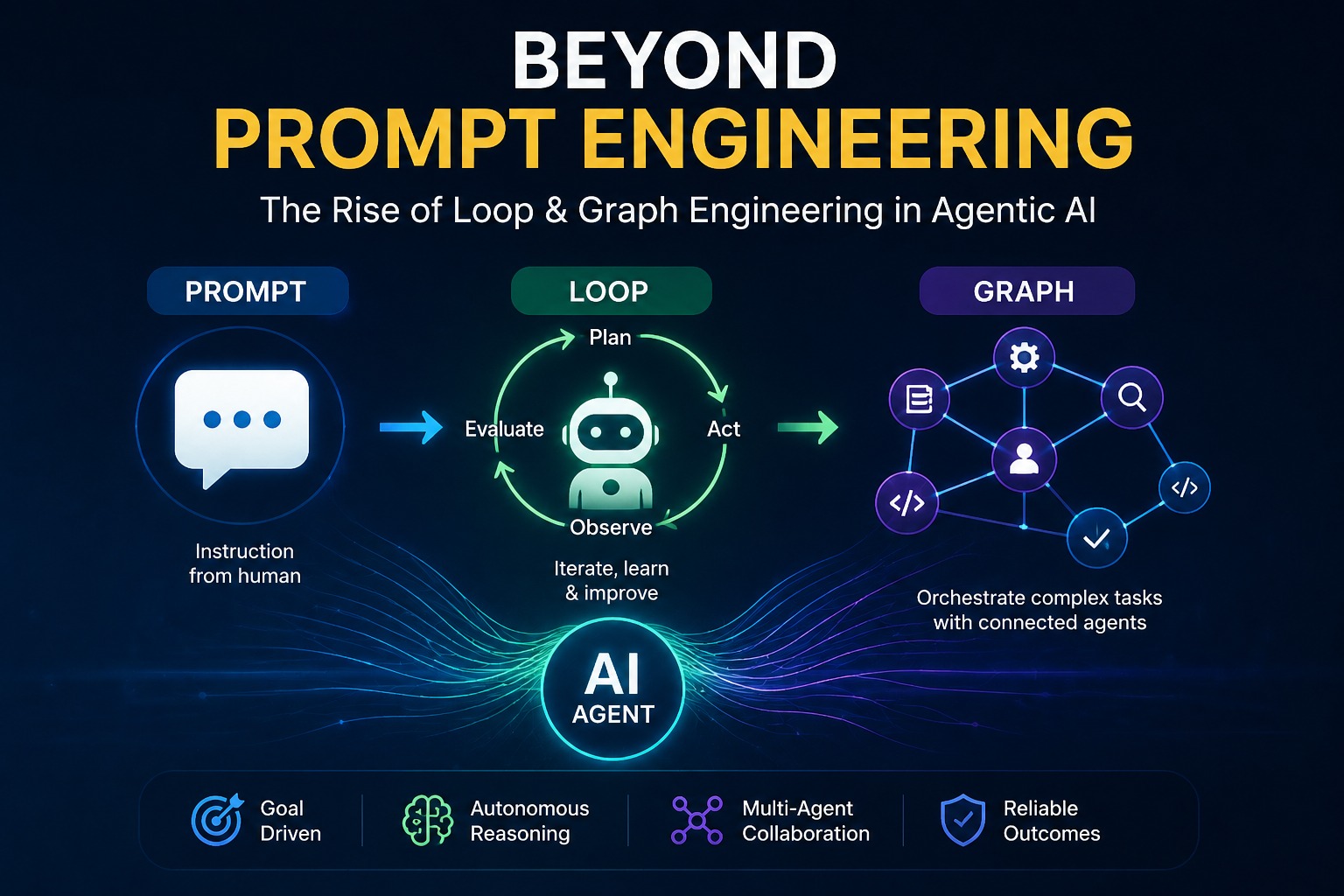
Loop Engineering is an emerging approach to building AI agents that can take an action, check the result, and try again when needed.
An agent loop can be understood through four simple stages:
Goal → Action → Observation → Adjustment→ Repeat → Done
First, the agent needs a clear goal. It then takes an action, observes the result, and decides what to do next based on that result. This cycle can continue until a defined completion condition is reached.
For example, consider an AI agent asked to improve the performance of a website.
Instead of a developer repeatedly saying:
“Try another optimization.”
“Run the tests.”
“Fix this error.”
“Try again.”
A well-designed loop could allow the agent to:
• Analyze the website.
• Identify a performance problem.
• Make an optimization.
• Run performance tests.
• Review the results.
• Make another change if the target has not been reached.
• Stop when the required performance criteria are satisfied.
The developer is no longer manually controlling every step. The developer is designing the loop that controls the work.
This makes verification and stopping conditions especially important. An agent should not continue working forever simply because it can. A good loop needs clear goals, useful feedback, access to the right tools, and a reliable condition for knowing when the task is complete.
Why Does Loop Engineering Matter?
Many real tasks cannot be completed correctly on the first attempt.
Loop Engineering can be useful for tasks that naturally require repetition and improvement.
Some examples include:
1. Software development and debugging
2. Automated testing
3. Data analysis
4. Research
5. Content review
6. Document processing
7. Cybersecurity tasks
8. Repetitive business processes
The main advantage is that the agent can respond to the results of its own actions instead of treating every step as a completely new conversation.
However, automation does not mean removing humans completely. Human review remains important, especially when an agent is working with sensitive information, production systems, financial decisions, or other high-impact tasks. IBM also highlights the importance of human oversight because automated agent loops can introduce issues such as unverified output and growing gaps between generated work and human understanding.
What Is Graph Engineering?
Loop Engineering works well when an agent needs to repeat a process. But many real-world tasks are more complicated than a single loop.
Imagine an AI research system that needs to:
Research a topic → collect sources → analyze information → write a report → verify the report → request approval → publish it.
Some tasks can happen in parallel. Some require a specific order. Some may need to go back to an earlier step if validation fails.
This is where Graph Engineering becomes useful.
Graph Engineering is a new methodology whereby an AI application can be expressed in terms of workflow that includes agents, tools, functions, data sources, validators, and human judgment, rather than having one single agent controlling the entire process.
A simple graph might look like:
Research Agent → Writing Agent → Review Agent → Human Approval → Final Output
The review process may fail, and at this point, the workflow will return the content to the writing phase without having to start all over again from scratch.
As mentioned earlier, in the case of a graph-based workflow, various nodes may have different functions. For instance, one node will execute the AI function, another may execute the Python function, the third node will retrieve data from a database, and yet another will request human approval.
A very important thing here is that not all nodes have to be AI agents. While deterministic processes should be left to regular software, AI can be deployed where reasoning and interpretation are needed.
Loop Engineering vs. Graph Engineering
Although the two approaches are related, they solve different problems.
Loop Engineering focuses mainly on iteration:
Act → Observe → Adjust → Repeat
It is useful when an agent needs to improve its work through repeated cycles.
Graph Engineering focuses on orchestration:
Node → Decision → Branch → Validation → Next Node
It is useful when a system contains multiple tasks, agents, tools, decision points, or human approvals.
In practice, they can work together. A graph may contain several nodes, and one of those nodes may itself contain an agentic loop.
This creates a more flexible architecture for complex AI applications.
The Benefits of These New AI Engineering Approaches
The move toward loops and graphs can provide several benefits.
Better Automation
An agent can work through several steps without needing a person to give an instruction each time .
More Reliable Workflows
Validation steps, testing, and approval points can be built directly into the process instead of being left entirely to the AI model.
Better Checking
Tests and review steps can be added to the workflow so that the agent does not simply produce an answer and stop.
Easier Scaling
Difficult tasks can be divided among specialized agents, tools, and software components rather than relying on one large agent to do everything.
Human Oversight
Humans can remain involved at important decision points without having to manually supervise every low-risk action.
Challenges to Consider
These approaches also bring new challenges and problems.
The more freedom an AI agent has, the more carefully it needs to be controlled.
An agent could make the wrong decision, repeat the same action too many times, use a tool incorrectly, or produce an answer that looks correct but is not.
There is also the problem of complexity.
If a system has too many agents, tools, and connections, it can become difficult to understand and maintain.
For this reason, developers should not add AI agents simply because they can.
A simple solution is often better than a complicated one.
The main goal should be to build a system that is useful, reliable, and easy to control.
The Future of AI Engineering
The development of AI is moving beyond the idea that better results simply require better prompts.
Prompt engineering remains an important part of the picture, but modern AI systems increasingly require engineers to think about the complete environment around an agent: its context, tools, memory, workflow, verification, and boundaries.
Loop Engineering provides a way to manage repeated agent actions and feedback. Graph Engineering provides a way to organize more complex workflows involving multiple agents, tools, decisions, and people.
Another emerging direction is Harness Engineering, which takes this idea even further by focusing on the environment and supporting systems that allow agents to work reliably. In an agent-first software development experiment, OpenAI described this work as designing environments, specifying intent, and building feedback systems that help coding agents perform complex tasks.
These ideas point toward a broader change in the role of AI engineers. Instead of simply writing prompts or building individual AI features, engineers are increasingly designing systems in which AI agents can work, evaluate results, recover from failures, and collaborate with other components.
Conclusion
AI engineering is entering a new stage.
The journey is moving from Prompt Engineering toward Context Engineering, Agentic AI, Loop Engineering, and Graph Engineering. Each approach addresses a different part of the challenge: giving AI the right instructions, providing the right information, enabling autonomous action, supporting iteration, and coordinating complex workflows.
The important lesson is that building a powerful AI system is no longer only about choosing a powerful model. It is also about designing the system around that model.
As AI agents become more capable, the engineers who can design reliable loops, structured graphs, effective tools, and safe execution environments will play an important role in the next generation of AI applications.
The future of AI may not simply be about asking AI better questions. It may be about engineering better systems in which AI can work.
